Abhiramon Rajasekharan

Welcome!
About Me
I’m a Ph.D. candidate in Computer Science at the University of Texas at Dallas. My research broadly falls into Neuro-Symbolic Reasoning, Explainable decision-making, and Code Generation under Low-Resource Settings. The goal of my research is to help LLMs perform better in reasoning tasks, especially in high-stakes domains such as healthcare and tax compliance where reliability and explainability are crucial. I develop methods that enable LLMs to capture reasoning as code (such as logic programs) which reduces hallucination and can produce human-readable explanations.
Skills
- LLM Agents
- LLM Fine-Tuning
- Reinforcement Learning
- World Modeling
- Logic Programming
Work Experience
-
Research Intern, Skyfall AI — New York City, NY (Remote)May 2025 – Aug 2025
Long-horizon planning for agents in stochastic business simulations via an LLM framework that learns dual code + probabilistic graphical world models; achieved 50-day bankruptcy-free survival in the Mini Amusement Parks benchmark.
-
Data Science Intern, AT&T — Plano, TX (Remote)June 2022 – Aug 2022
Name-spinnig fraud detection via a novel name part mapping algorithm using character-embeddings (PyTorch); improved F1 score from 19% to 46%.
-
Research Intern, Accenture Labs — Bangalore, IndiaJuly 2019 – Dec 2019
Stock movement classification via an LSTM + R-GCN model learned from company knowledge graphs and financial news.
-
Summer Analyst, Goldman Sachs — Bangalore, IndiaMay 2019 – Jun 2019
Complex data retrieval automation via Spring Boot and Elasticsearch; system deployed to production.
Selected Publications
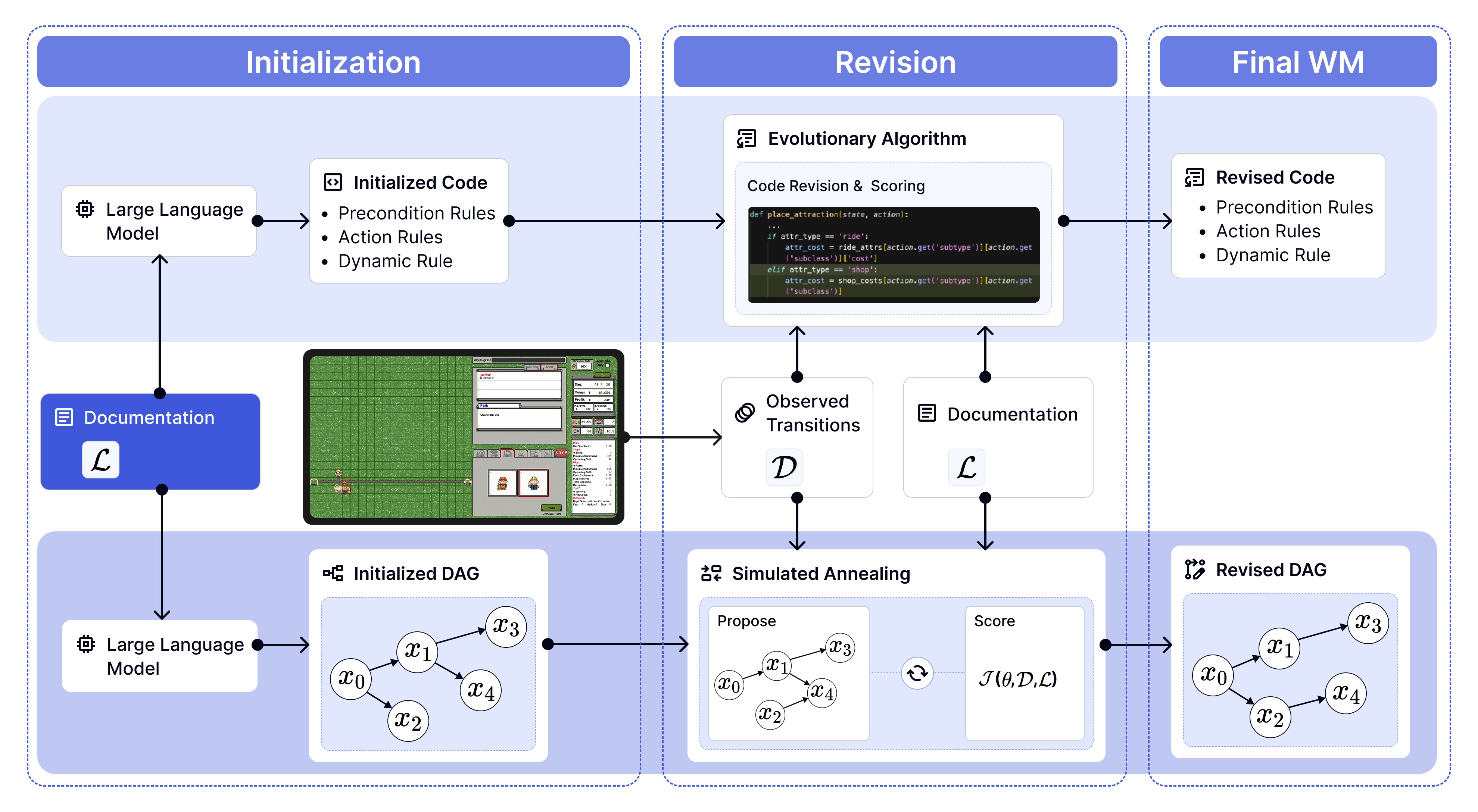
CASSANDRA: Programmatic and Probabilistic Learning and Inference for Stochastic World Modeling
Introduces CASSANDRA, a dual-stream framework that integrates code and probabilistic graphical models for stochastic world modeling. The system learns lightweight, executable world models that support long-horizon planning in complex environments. Empirically, it helps a planning agent achieve 50-day bankruptcy-free survival in the Mini Amusement Parks benchmark, significantly outperforming comparable LLM-based world models.
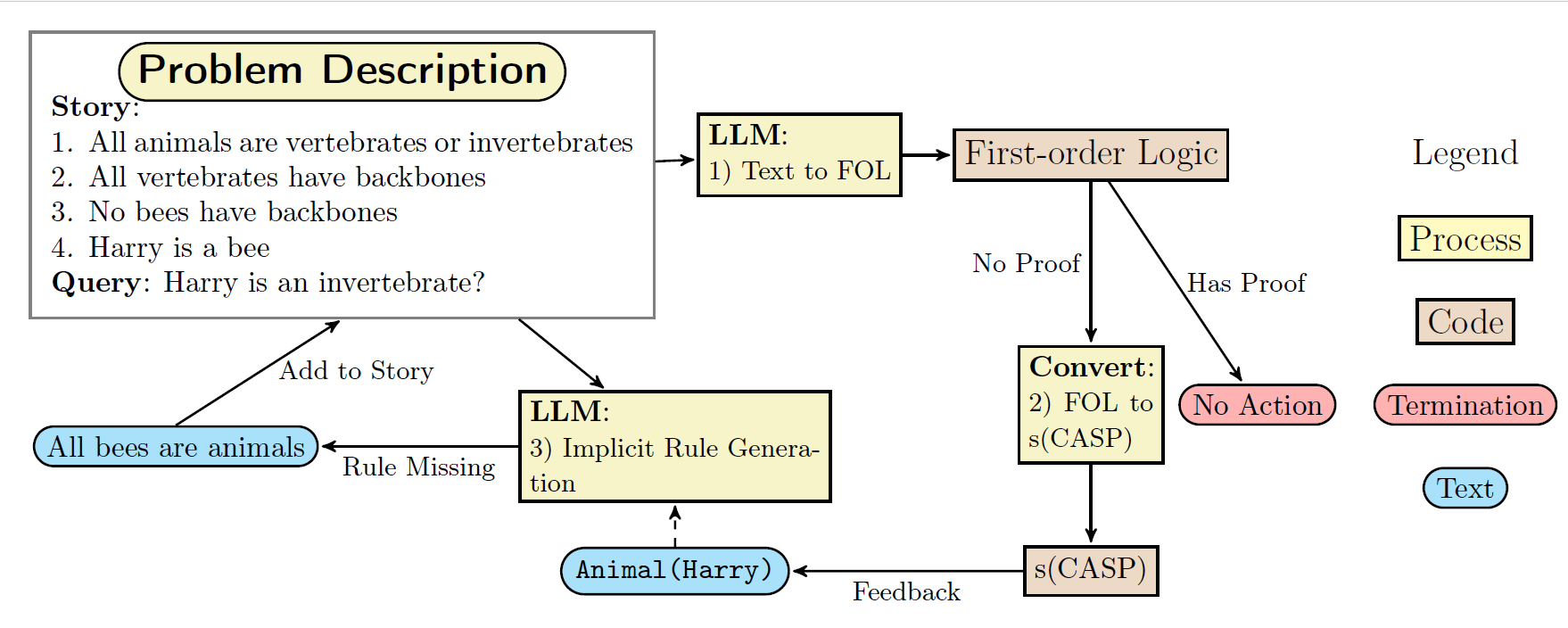
REGAL: Reconstructing Implicit Logic Rules
Presents a novel framework for implicit rule reconstruction, addressing a key limitation of text-to-logic systems: their inability to recover implicit commonsense rules. REGAL introduces an iterative reasoning pipeline that reconstructs missing logical assumptions, enabling more complete and faithful logical representations of natural language reasoning problems.
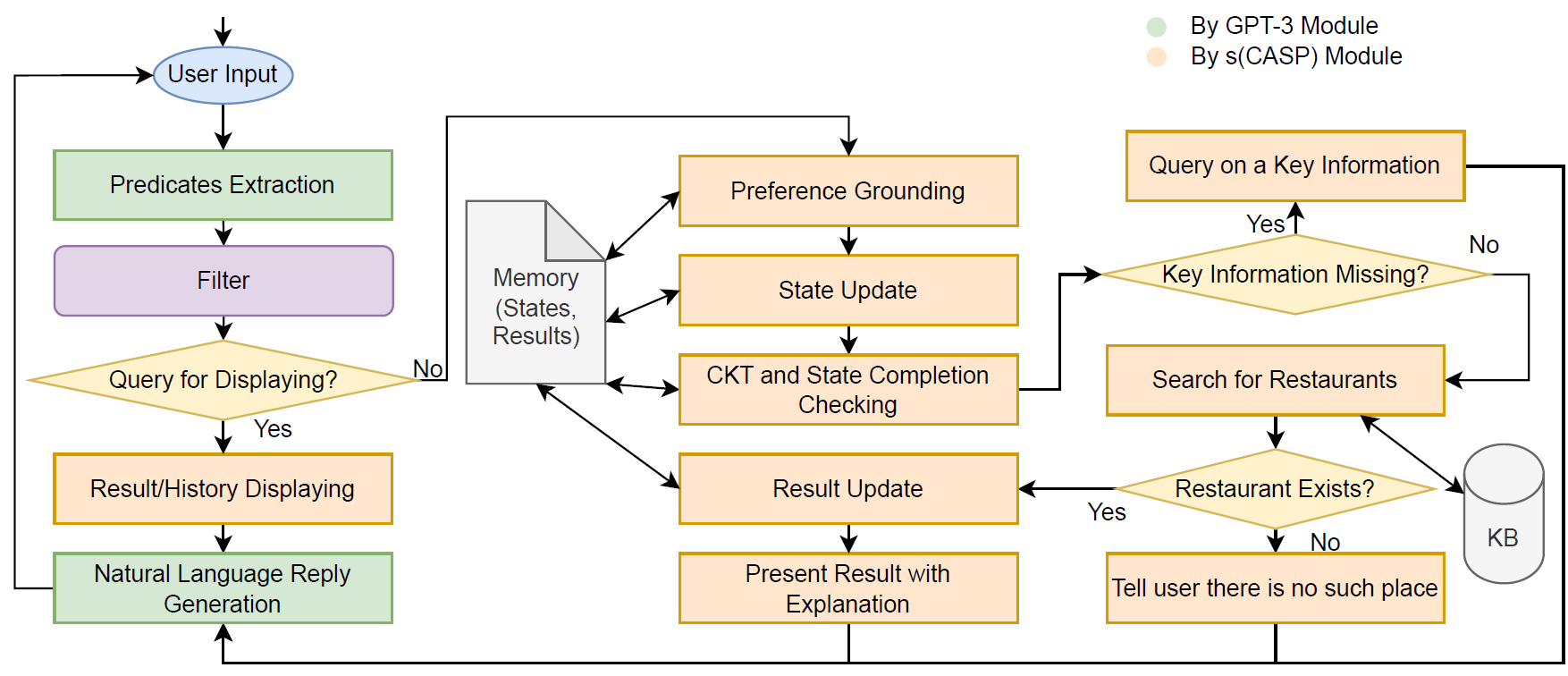
Automated Interactive Domain-Specific Conversational Agents that Understand Human Dialogs
Develops a framework for goal-directed conversational agents using Answer Set Programming (ASP). Unlike purely neural approaches, the system ensures conversations remain logically consistent, controllable, and aligned with task objectives.
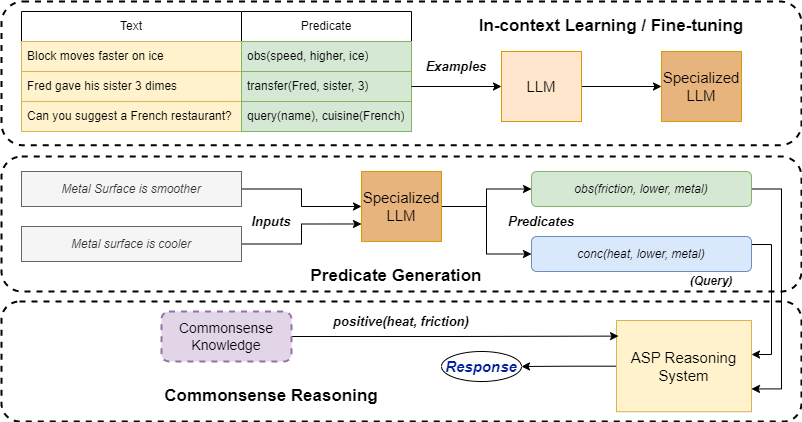
Reliable Natural Language Reasoning using ASP and LLMs
Introduces the STAR framework, a neuro-symbolic system combining LLM-based predicate extraction with Answer Set Programming for reliable reasoning. The approach achieves significant improvements on a qualitative reasoning benchmark (QuaRel), especially for smaller LLMs.
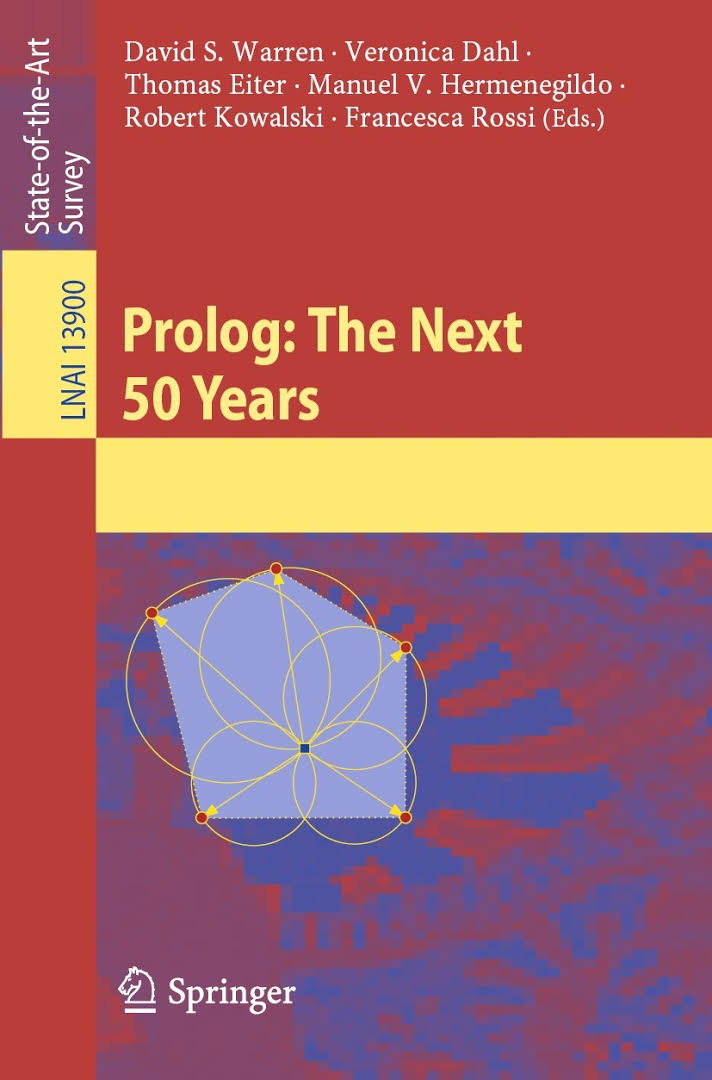
Prolog: past, present, and future
Provides a forward-looking perspective on logic programming, highlighting how goal-directed predicate Answer Set Programming extends Prolog to support modern AI applications, including commonsense reasoning and complex decision-making systems.
See my Google Scholar page for complete list.
Education
-
Doctor of Philosophy – PhD, Computer Science The University of Texas at DallasAug 2020 – Aug 2026
-
Integrated Masters (BTech + MTech), Computer Science International Institute of Information Technology Bangalore2015 – 2020
Master's Thesis: Addressed the unique challenge of creating rhyming poetry from image captions; developed GPT-2 based model with a novel loss function, increasing rhyme density by 17%.